Soil investigation: a prerequisite for effective foundation repair
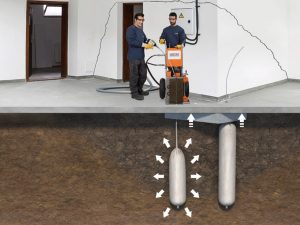
URETEK is recognised worldwide as a specialist in high-quality technical solutions for the rehabilitation of subsided concrete floors and foundations.

To achieve a reliable result, it is not only important to have a thorough understanding of the foundation’s design, but also to have information about the nature and composition of the subsoil. For this reason, URETEK requests that you provide the building plans and the results of the ground investigation. Based on this information, we can determine the most suitable method for foundation levelling.
Soil investigation reports for foundation lowering
There are various techniques for investigating the mechanical properties of the subsoil. A distinction is made between the ‘static penetrometer test’ and the ‘dynamic penetrometer test’. ‘Static’ means that the probe (a metal tube with a tip of standardised dimensions) is hydraulically driven into the ground at a constant speed. The resistance encountered is measured and plotted on a graph, which constitutes the result of the probing. For harder soils, the dynamic test is used. Here, the probe is driven into the ground with a defined weight and from a defined drop height. The number of blows per 10 cm of depth is counted and also plotted on a graph: the result of the sounding per blow.
Example of a sounding result for soil injection
These tests provide a definitive answer regarding the mechanical properties of the subsoil. To gain a precise understanding of the nature of the subsoil (sand, clay, peat, etc.), its moisture content and the level of the water table, soil investigations must be carried out. During this process, soil samples are taken. A specialist laboratory then analyses the samples and determines the nature and moisture content of the soil. For URETEK, the availability of soil condition reports is often a prerequisite for accepting a contract for ground improvement. For soil analysis, we frequently collaborate with renowned geomechanical engineering firms to rule out any risks. Whilst our method is cost-effective, it does have its limitations and is not applicable in all cases.
Requirements for soil investigation
A geotechnical soil investigation provides insights into the structure of the soil layers. The soil investigation report must contain at least the following information:
– Soil probing (depth of at least 10 metres) with cone resistance and friction coefficient
– Borehole data (depth at least 4 metres)
– Water table.
It is recommended that a sounding test be carried out at at least two different locations. This makes it easier to identify any differences in the structure of the soil layers.
Soil investigation companies in Belgium
Samsuffit Geo Service BVBA
www.samsuffit.be
Geonius Geotechniek BV
www.geonius.nl
SGS Belgium NV
www.sgs.be
INISMa
www.inisma.be
Soil investigation companies in the Netherlands
Fugro GeoServices BV
www.fugro.nl
Geonius Hoogveld BV
www.geonius.nl
Hoogveld Sonderingen BV
www.sondeerbedrijf.nl
Socotec Geotechnics BV
www.socotec.nl/diensten/geotechniek-milieuonderzoek/grondonderzoek
Mos grondmechanica
www.mosgeo.com
Van der Straaten Aannemingsmaatschappij BV
www.vd-straaten.nl
Tjaden Adviesbureau voor Grondmechanica BV
www.tjadenadvies.nl
Wiertsema & Partners – Consulting Engineers
www.wiertsema.nl
Sondertechniek – Beam Bridge
www.sondeertechniek.nl
Our unique and tried-and-tested methods
Chez URETEK, nous sommes fiers de nos techniques avancées qui offrent des solutions durables aux fondations affaissées et instables. Nos méthodes sont conçues pour agir rapidement, efficacement et avec un minimum de perturbations, garantissant ainsi la sécurité et la stabilité de votre propriété. Poursuivez votre lecture pour découvrir comment nos approches uniques peuvent vous aider à réparer et à renforcer vos fondations.